Monday, July 16, 2018

Lesson 3: Finding and evaluating records


Lesson 3: Finding and evaluating records
Report:
Share with the group your successes and challenges in interviewing an ancestor and uploading photos and stories on Family Search.
1. Make goals
Read:
In the first lesson you identified some of your family history goals and started a plan to complete them. This exercise can also be used on a smaller scale to help with your family history research.
Research is the collecting of information on a particular subject (https://www.merriam-webster.com/dictionary/research), so the goal of family history research is to collect information about specific people in your family.
Activity:
Choose an ancestor on your tree and review the information available about that person. What information is missing? Are there records attached to that person that prove that the information is correct? Write down some questions about this person based on the missing information.
1.
2.
3.
Read:
Research questions, like those you wrote in the activity, are a good way to plan your family history research. You may find it useful to write down your research questions and the answers if you can find them so that you can stay organized when you are searching for information.
If you need to seek help from a family history consultant or expert, it is helpful for the consultant to know what information you want to find. Coming prepared with research questions will help you make the most of your time with the consultant.
2. Find family history information
Read:
The Family Search wiki is a crowd-sourced encyclopedia of family history information. It is a great place to learn what kinds of records are available for your ancestors and where to find them.
Activity:
On your smartphone, tablet, or computer go to https://familysearch.org/wiki. Look up a country or place where you think your ancestors lived and find out what types of records are available for that country.
Discuss:
Where do you think you should search for family history information? Are there online resources available for your ancestors?
3. Edit your tree
Activity:
Using your smartphone, tablet, or computer find and attach a record to someone in your tree on Family Search.
Read:
Evaluating and making conclusions based on the records is just as important as finding them. Look at them critically. Ask yourself questions about the records you find. Sometimes you will find seemingly or actually conflicting records and you will have to decide how to reconcile the information. As you become more experienced, this aspect of genealogy will get easier. Ask for advice from a consultant or expert when necessary.
Activity:
Below is an example of a census record from 1871 in Abertillery, Monmouthshire, Wales. As a group discuss what conclusions you can draw about the Barnes family based on this record? For example, ages, occupation, family dynamics, etc. How could you verify this information?


Commit:
Choose an ancestor who was born in the 1800s and focus your research on that person this week. Find as many records for that person and their family as you can. You can use the ancestor snapshot sheet below as a research journal or create your own.


Homework:
Find as many records as you can for one of your ancestors and their family. Use the ancestor snapshot sheet or a research journal to keep track of what you find.

Lesson 2: Preserving memories


Lesson 2: Preserving memories
Report:
Share with the group your successes and challenges in signing up for Family Search and partner sites you think you will use and completing and checking the first four generations of your tree.
1. Make goals
Read:
“When the Savior visited this continent following his resurrection, he commanded the Nephites and Lamanites to bring their records up to date. He said to them: “Behold, other scriptures I would that ye should write, that ye have not.
“And it came to pass that he said unto Nephi: Bring forth the record which ye have kept.
“And when Nephi had brought forth the records, and laid them before him, he cast his eyes upon them and said:
“Verily I say unto you, I commanded my servant Samuel, the Lamanite, that he should testify unto this people, that at the day that the Father should glorify his name in me that there were many saints who should arise from the dead, and should appear unto many, and should minister unto them. And he said unto them: Was it not so?
“And his disciples answered him and said: Yea, Lord, …
“And Jesus said unto them: How be it that ye have not written this thing, that many saints did arise and appear unto many and did minister unto them?
“And it came to pass that Nephi remembered that this thing had not been written, … therefore it was written according as he commanded.” (3 Ne. 23:6–13.)
“I am glad that it was not I who was reprimanded, even though mildly and kindly, for not having fulfilled the obligation to write the records and keep them up to date.
“And again in our day the Lord said to the Prophet Joseph Smith, “And again, let all the records be had in order, that they may be put in the archives of my holy temple” (D&C 127:9).
“You should continue on in this important work of recording the things you do, the things you say, the things you think, to be in accordance with the instructions of the Lord. Your story should be written now while it is fresh and while the true details are available.” (Kimball December 1980 New Era)
Discuss:
Why do you think the Lord has commanded us to keep personal records?
Commit:
If you haven’t already, decide how you will keep the Lord’s commandment to keep a personal record.
2. Find family history information
Read:
Some of the most abundant sources of family history information are hiding in your own family. Your living relatives can often tell you details about themselves and other ancestors that can’t be found elsewhere. In addition to providing vital statistics such as approximate birth and death dates, living relatives can help you get to know your ancestors by telling you stories about them. They may also have pictures or journals with even more information.
You may be surprised at how many generations back you can reach by talking to older relatives. For example, someone who was born in 1930 may be able to tell you about an ancestor born as early as 1850. As your relatives age, recording their memories becomes more time sensitive. Once the relatives are gone, their unrecorded memories are gone too.
It can sometimes be awkward to ask someone about their memories, but most people enjoy talking about themselves. Make sure to let the person know you are listening and interested with your facial expressions and body language. If you are going to take notes or record the conversation, ask permission first.
Activity:
Identify a family or ancestor in your tree that you would like to know more about.
 Who could you contact to find out more?

Write some questions you could ask below. You will get more information if you keep the questions general. For example, “What did that person look like?” will get you more information than “Did that person wear glasses?”
1.
2.
3.
4.
5.
Commit:
Commit to interview a relative this week. You can make an appointment and prepare questions, or you can casually bring it up in a phone conversation or at a family gathering. Either way, make sure to record what you learn so you don’t forget.
3. Edit your family tree
Read:
Uploading photos and stories to Family Search is a great way to preserve your family’s memories. You can upload photos and stories on the computer or on your phone using Family Search Memories app.
Watch:
Activity:
Using your smartphone, tablet, or computer add a memory to Family Search now. The woman on the video uploads a photo using her computer. If you are using the app some features may be a little different. Help each other and try to figure it out together.
Commit:
Upload more stories and photos to Family Search this week. This would be an appropriate activity for Family Home Evening.
Homework:
Decide how you will keep your personal record
Interview a relative
Upload a photo or story to Family Search

Lesson 1: Intro to Family Search


Lesson 1: Intro to Family Search
Read:
In this course we will focus on three steps for family history research.
1. Make goals
2. Find family history information
3. Edit your family tree
1. Make goals
Read:
“Over the years, I have observed that those who accomplish the most in this world are those with a vision for their lives, with goals to keep them focused on their vision and tactical plans for how to achieve them…
Goal setting is essentially beginning with the end in mind. And planning is devising a way to get to that end. A key to happiness lies in understanding what destinations truly matter—and then spending our time, effort, and attention on the things that constitute a sure way to arrive there.” (Return and receive M Russel Ballard April 2017)
Activity:
Identify some of your family history goals and write them down below. Begin a plan to achieve them by listing three steps you think will be necessary for you to succeed.
Goal
Plan


2. Find family history information
Read:
There are many places to find family history information. Below is a list some available resources.
Family members
Ancestor’s journals
Family history websites
Government offices
Books
Libraries
Genealogical societies
Graveyards
Discuss:
Which of these sources do you think will be most valuable to you? Why? Can you think of any other sources that you may be able to use?
Read:
If you are interested in submitting names for the temple, you will need a Family Search account. Family Search is one of the biggest family history websites and it is completely free.
Watch:
Commit:
If you have not already, sign up for an account on FamilySearch.org sometime this week. If you have a membership record number attach it to your account so you can submit names for the temple. Your membership record number is available from your ward clerk or on your two-year temple recommend if you have one. If you are using a smartphone or tablet in class, download the FamilySearch app and sign in to your account. Take some time to familiarize yourself with the website and app.
Baptized members of the Church over the age of 13 are also eligible for free accounts on Family Search partner sites. After you sign up for Family Search you can access your partner accounts at familysearch.org/partneraccess. This week sign up for any partner sites you think may be useful to you.
3. Edit your family tree
Read:
There may already be several versions of your tree available to you through family members or online. You may have created a tree using paper, a computer software program (like PAF), or on a family history website. In this course we will focus on the tree you will create and maintain on Family Search. Watch the video to learn how to start your family tree on Family Search.
Watch:
Read:
Many family history websites allow you to upload a tree to which you can edit and make public if you wish. Family Search is unique in that users’ family trees link together to create one tree that all users have the ability to edit. It is important to have only one record of each unique individual on Family Search so that temple ordinances are not performed for that person more than once.
Discuss:
What are the benefits and challenges of a “master” family tree like the one available on Family Search?
Read:
Family Search was created by merging together many different genealogies and there may have been mistakes in the merging process. Also, other users may have added incorrect information to your ancestor’s records or even accidentally replaced your ancestor with someone else. You will need to do your own research to verify that the tree you find on Family Search is accurate. Start with your closest ancestors and work backwards.
Commit:
If you haven’t already, start your family tree on Family Search. You will need to talk to family members, if possible, to verify the first four generations of your tree as it appears on Family Search. Edit your ancestors’ details based on your family records as needed.
Homework:
Sign up for Family Search and partner sites you think you will use.
Complete and check the first four generations of your tree if possible.

Sunday, March 20, 2016

Cute family tree printables from Family Search

I love the fan chart, don't get me wrong but I can see how it may not match everyone's decor. Luckily Family Search has just launched keepsakes. Here's what they look like. You can also include your children's names.


Cute, right? And super easy to make. Really, it only takes two minutes.

Tuesday, October 20, 2015

How Pride and Prejudice can help you learn about your ancestors

I don't have any stories about most of my ancestors. I try to piece together what I can based on what I can find, but I'll never know much about their day-to-day lives by looking at the census. Usually I have to guess.

I recently realized, though, that some of my favourite books were written in the 1800s. Pride and Prejudice, for example, was published in 1813, when my ancestor, Grace Harry, was 8 years old and living in Cornwall, England. While I'm sure the characters in the book are far more wealthy than Grace ever was or even hoped to be, small details in the book might give me insight into her life that I couldn't find elsewhere. Maybe she was a maid....

TV shows and movies are relevant too (though books that were actually written by people who lived at the time period are probably more accurate). In Downton Abbey, for instance, the three daughters probably would have been born in the 1890s, while the Dowager Countess could have been born in the 1840s or earlier. The show could just as easily been written about my Barnes and Newman ancestors (if it were a show about coal miners).

Below is a list of some classic books with their publication dates (special thanks to wikipedia for supplying the publication dates). Many of these books have been adapted into movies as well. Keep in mind these books are mostly about adults and would correspond to ancestors born between 20 and 50 years before these publication dates.


United Kingdom and Ireland

Pride and Prejudice - 1813

Frankenstein - 1818

Jane Eyre - 1847

Great Expectations - 1861

Black Beauty - 1877

Sherlock Holmes - 1887

The Importance of Being Ernest - 1895

A Little Princess - 1905

Secret Garden - 1911

United States and Canada

The Legend of Sleepy Hollow - 1820

The Scarlet letter - 1850

Uncle Tom's Cabin - 1852

Little Women - 1868

Little House on the Prairie - published 1932, takes place in the 1870s

Adventures of Huckleberry Finn - 1885

Sarah, Plain and Tall - 1895

Anne of Green Gables - 1908

Gone with the Wind - 1936

Europe

The Count of Monte Cristo - published 1844 France, takes place 1815-1839

Les Miserables - published 1862 France, takes place 1815-1832

Anna Karenina - 1877 Russia

Heidi - 1881 Switzerland

What did I miss? What are your favourite books and movies about the times when your ancestors lived? Comment below and I'll add them to the list.

Photo by Naypong. Published on 05 November 2014 Stock photo - Image ID: 100296203

Seek ye out of the best genealogy sources accurate information

D&C 88:118 ... seek ye out of the best books words of wisdom...

Recently I came across an article called "The Huge Genealogy Mistake We All Need to Stop Making Now". Those kind of leading titles always get me and I'm usually disappointed but this one was good.

What's the huge mistake? Copying someone else's genealogy research, particularly public online family trees. I still highly recommend the article (even though I ruined the surprise) because it explains four very important reasons to stop copying other people's research. Instead of repeating them (and thereby plagiarizing an article on plagiarism) I'm going to focus on what to do instead.

It's an easy mistake to make. Genealogy sites are begging you to do it. Family Search literally creates your tree by copying it from someone else. Other genealogy sites find matches between your tree and other trees automatically and allow you to connect those people and share research. They encourage you to use other people's family trees as proof that your family tree is correct. But other people's family trees don't prove that your tree is correct.

There are two types of sources. Primary sources come from the time your ancestors lived. Birth, marriage and death records, military records, censuses, personal journals, memories - anything created in real time. Primary sources are usually accurate.


Gravestones are another example of a primary source

Secondary sources are created later, using the primary sources. Family trees, genealogies, books, blogs and websites, binders of research passed down by your great aunt. Secondary sources can be accurate if the person who created them was right, but they could be totally wrong if the person who created them made a mistake.

So are secondary sources completely useless? No. They're a great jumping off point. It's much easier to verify something you think might be true than it is to start from scratch.

Here's an example. You are looking for Eliza's parents. You've searched her name on several genealogy sites and she shows up on a few public family trees. The family trees look right because they've got her husband and children on there too. Most of the family trees say that her parents are William and Catherine in a small town in Wales. How does this help you? It changes your research question. 

You were asking "Who are Eliza's parents?" but after seeing those family trees you can ask "Are Eliza's parents William and Catherine?". The second question is much easier to answer. With three people to look for and a specific place you are much more likely to find good primary sources for Eliza.

You have to be careful, though. Proving that there were a William and Catherine who had a daughter named Eliza isn't enough. You have to prove (or disprove) that it's the right Eliza - the one who grew up to be your ancestor. Look for primary sources that link adult Eliza to her parents, or that link William and Catherine's Eliza to a different grown-up family. Marriage and death records sometimes list the parents. Sometimes adult Eliza will show up in the census living with her parents or one of her siblings. Sometimes young Eliza's sister will list adult Eliza as a witness on her marriage record. It may take a while, but you will have lots to look for.

When you do find some good primary sources attach them to your family tree! You're a secondary source too and you can make it easy for other people to verify your research. Be the tree you'd like to see in the world. :)

Photocredit: Marc Aert. Published on 18 October 2008 Stock photo - Image ID: 1001206

Monday, September 14, 2015

Ancestor Snapshot Sheets: A three week Sunday lesson curriculum

The effort to teach youth about genealogy often focuses on finding new ancestors. I think this is a mistake. Sometimes.

It's exciting to find a new ancestor, and for LDS youth it often completes a goal to find ancestor's names to bring to the temple. It's good for them to complete their goals and the excitement can fuel a love of genealogy for the rest of their lives.

Unfortunately, finding new names (or finding existing names that still need temple ordinances) doesn't teach the research skills that will help youth become the kind of people who do family history on a regular basis.

Also, their whole family tree could be completely wrong. I always recommend that beginner genealogists start with the most recently deceased ancestor for each of their lines, even (especially) if they can trace themselves back to Adam on FamilySearch. Youth should do this with their parents, if possible, until they get back to ancestors born in the 1800s.

Why the 1800s? It is the golden age for online genealogy research. Pre-1800s records available online range from sketchy to non-existent. Post-1800s records usually aren't publicly available yet. 

Okay, so (finally) here is the Sunday lesson curriculum I promised. The August youth Sunday School curriculum suggests several lessons about family history, so that might be a good time to do these lessons. I think these lessons would work best if they were taught for three consecutive weeks.

Week 1:

The purpose of this lesson is for the youth to get to know one of their ancestors and to start to think of their ancestors as "real people" to whom they can relate. This lesson is also meant to help the youth identify research questions for the ancestor that they choose.

You will need:

  • A class of (preferably) no more than 10 youth on their Sunday behaviour
  • An internet-connected computer for each youth
  • An adult helper for every 2-3 youth
  • Pens and highlighters for each youth
  • The handouts below

Have the youth log on to Family Search and choose an ancestor born between 1800 and 1900 who has an exact birth year. A few youth may not have an ancestor on Family Search that fits these criteria. They can work with a friend, but it would be better to try to get their parents or other family members involved and have them work on a more recent ancestor.

Invite youth to work on this ancestor snapshot sheet in order to get to know their ancestor. Tell them to highlight and leave blank any information that is missing (these are the research questions).


Many of the youth will have no problem completing this worksheet on their own; others will need step by step help. Some youth will need help calculating their ancestor's age and some may not know what an "occupation" is. Adult helpers are there to answer these sorts of questions, but it's even better if the youth help each other.

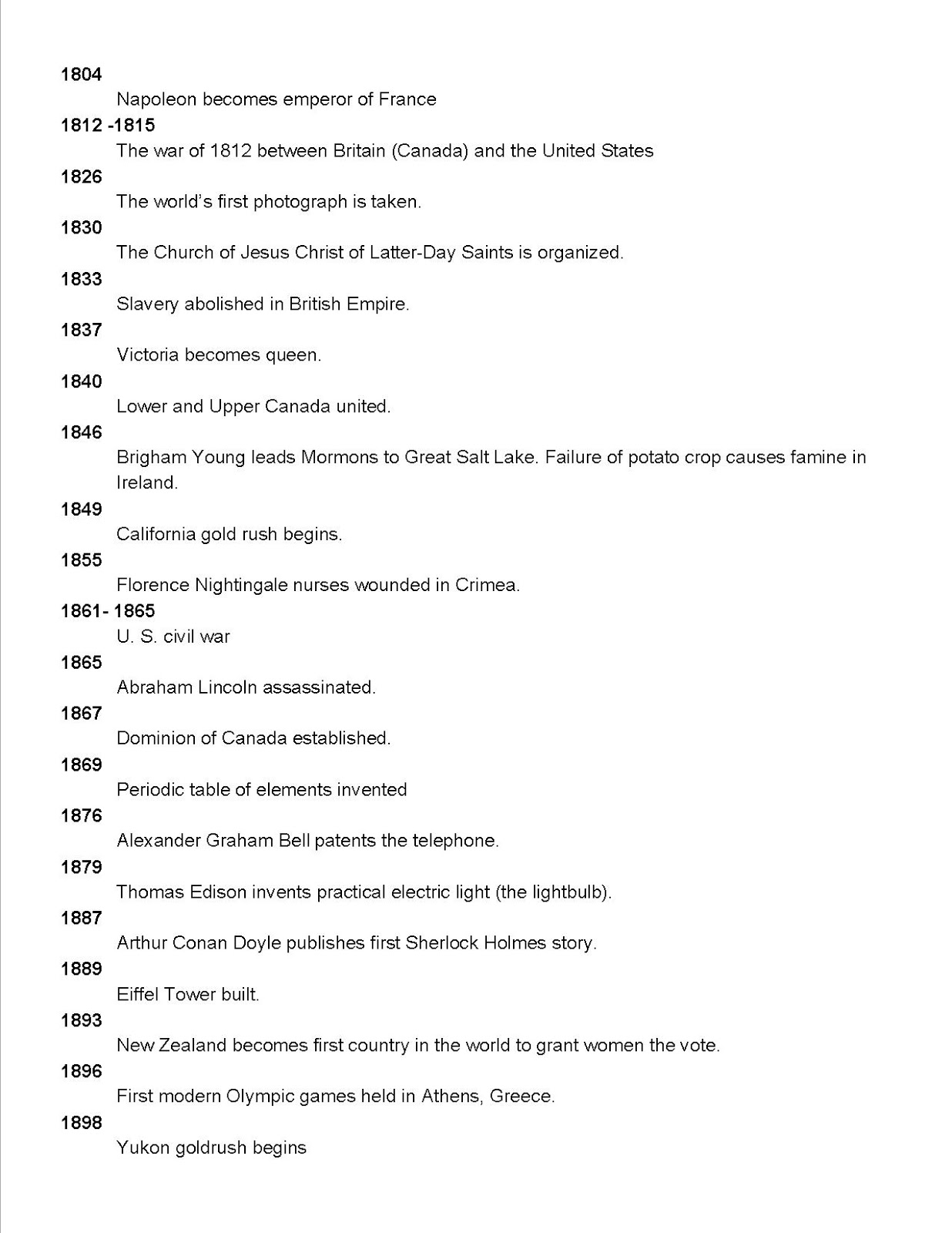
For the historical events I prepared a world history handout using information I found on infoplease.com. I selected events that I thought the youth in my (Canadian) ward would recognize, so you may want to prepare your own for the youth in your area.


 Some youth will be able to finish this worksheet in one class period and others won't depending on the available information on their Family Search. Either way, I suggest collecting their work at the end of the class period or you may never see it again.

Week 2:

The purpose of this lesson is to teach youth how to find and record answers to research questions using online resources.

You will need:
  • A class of (preferably) no more than 10 youth on their Sunday behaviour
  • An internet-connected computer for each youth with access to premium family history websites (like ancestry.com)
  • A family history expert for every 1-2 youth
  • Pens for each youth
  • The snapshot sheets from the week before
Have the family history experts review the highlighted portions of the snapshots sheets in advance, if possible, and identify the research questions which will be the easiest to answer using online resources. Try to make sure each youth has a few research questions that they will be able to answer during class time. It's important for everyone to have some sort of success in order to build their confidence. For youth who were able to find all of the information for the snapshot, focus on adding sources to the ancestor's Family Search page. It is unlikely that all of the available sources have been already added to Family Search.

When the youth arrive for class, give them back their worksheets from the previous week and invite them to work with the family history experts to fill in the highlighted blanks on their sheet. Some youth may want to complete their worksheets first, but most of their time should be spent on online research if possible.

Encourage the family history experts to let the youth lead as much as possible. Let them figure out the search terms on their own. Let them make their search too broad or specific and then explain to them how to improve it. The experts should not touch the computers.

When the youth find out new information about their ancestor, teach them how to add it to Family Search. You can add any kind of event or tidbit in the "Other Information" section on the ancestor's detail page. This will teach them how to edit their ancestors on Family Search. Then teach the youth how to add sources to their ancestor's page on Family Search and make sure they know that they should do this every time they find a new source for their ancestor.

By the end of the class period each youth should have found some sort of new information about their ancestor by searching for records on Family Search or another genealogy website. They should also know how to update their ancestor's details and add sources on Family Search.

If the youth have completed their ancestor snapshot sheets, let them bring them home and encourage them to talk about it with their families. For youth who have not completed their worksheets give them a choice between finishing them at home or at the next class period.

For the next lesson youth will have a choice between continuing work on their ancestor snapshot sheets or teaching what they have learned to someone else. Have them make that choice at the end of this lesson and ask them to bring someone (an adult) to teach for next week if they would like to teach. The youth will be most comfortable teaching someone they know.

Week 3:

The purpose of this lesson is to allow extra time for youth to complete the ancestor snapshot sheets or to allow youth to teach what they have learned.

You will need:
  • A class of (preferably) no more than 10 youth on their Sunday behaviour
  • An internet-connected computer for each youth with access to premium family history websites (like ancestry.com)
  • A family history expert for every 2-3 youth who are finishing their ancestor snapshot sheets
  • An adult who wants to learn about family history for each youth who is ready to teach
  • Pens and highlighters
  • Extra copies of the ancestor snapshot and historical events handouts
For youth that want to continue working on their ancestor snapshot sheets, try to let them do as much as they can on their own. The family history experts should play a minimal role this week, only answering questions when asked.

For youth that want to teach, give them the blank handouts and ask them to teach the adult how to complete it. They can choose ancestors from the youth's family tree or from the adult's family tree, but the adult should be sitting at the computer.

Tell the youth who are teaching that they should not be touching the computers, only explaining what to do. Encourage them to ask questions that will help the adults think about the ancestor as a real person, like "Oh this ancestor had 10 children. How many children do you have? How do you think you would feel if you had 10 children?"

Encourage the adults who are learning from the youth to let the youth lead completely. Ask lots of questions, especially questions that they think the youth will know how to answer. The youth should come away from the experience feeling empowered and knowledgeable. The adults should make this their goal.

At the end of the class period encourage youth who were working on their ancestor snapshot sheets to finish them at home with their families or to finish them with an expert at the local family history centre. Encourage youth who were teaching to consider helping their adult finish the ancestor snapshot sheet another time at their home or at the family history centre.

Make sure to mention that the youth could also teach their families these skills at a family home evening as part of their Personal Progress or Duty to God programs.